Hydration vs. Moisturization: What Your Skin Really Needs
By Dr. Desiree Eakin | EAKINMD Physician-Formulated Skincare
Have you ever applied moisturizer only to find that your skin still feels tight or dry a few hours later? Or perhaps your skin looks oily but somehow feels dehydrated?
One of the most common misconceptions about skincare is that hydration and moisturization are the same thing.
They're not.
Understanding the difference can help you choose products more effectively and build a routine that supports your skin's natural function.
Your skin doesn't just need water. It needs the ability to hold on to it.
Hydration vs. Moisturization: What's the Difference?
Although the terms are often used interchangeably, hydration and moisturization serve different purposes.
Hydration refers to increasing the water content within the skin's outer layers. Ingredients called humectants, such as hyaluronic acid and glycerin, attract and bind water, helping skin appear smoother and more supple.
Moisturization involves improving skin softness and reducing moisture loss. Moisturizers often combine humectants with emollients and occlusive ingredients that help replenish the skin's protective barrier.
Think of hydration as providing water and moisturization as helping your skin retain it.
Both are important, and the right balance depends on your individual skin needs.
Why Your Skin Barrier Matters
Your skin's outermost layer serves as a protective barrier, helping retain moisture while limiting exposure to environmental irritants.
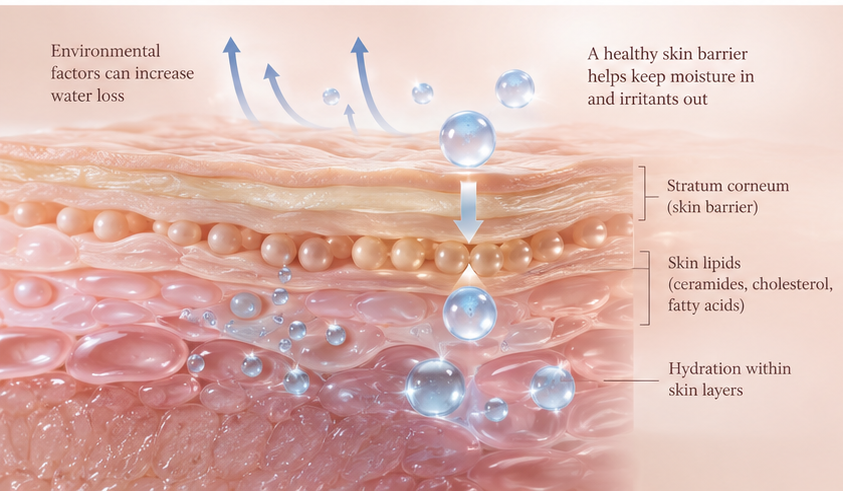
When this barrier becomes disrupted, water escapes more easily through a process called transepidermal water loss (TEWL).
The result may be skin that feels tight, rough, flaky, or unusually sensitive.
Common contributors include harsh cleansing products, excessive exfoliation, cold weather, low humidity, and certain skincare treatments.
Aging and hormonal changes can also affect skin hydration. During perimenopause and menopause, declining estrogen levels may contribute to increased dryness and changes in skin texture.
This is one reason I encourage patients to consider how their skin is functioning rather than focusing exclusively on how it looks.
Hyaluronic Acid: Why It's So Popular
Hyaluronic acid is a substance naturally present in the skin that plays an important role in maintaining hydration.
In skincare, it acts as a humectant, helping attract and bind water at the skin's surface.
When incorporated into a well-formulated product, hyaluronic acid can temporarily improve skin hydration, enhance suppleness, and soften the appearance of fine lines associated with dehydration.
However, hyaluronic acid isn't a substitute for moisturizer.
For many people, following a hydrating serum with a moisturizer provides a more complete approach, particularly when the skin barrier is compromised or the environment is dry.
Can Oily Skin Be Dehydrated?
Absolutely.
Oily skin and dehydrated skin are not opposites.
Oiliness refers to sebum production, while dehydration refers to insufficient water in the skin's outer layers.
You can produce excess oil and still experience tightness, roughness, or fine lines associated with dehydration.
This sometimes happens when people use overly aggressive cleansers or avoid moisturizers because they're concerned about clogged pores.
The solution isn't necessarily a heavier cream. It may be a lightweight hydrating serum paired with an appropriate moisturizer.
The EAKINMD Approach to Hydration
At EAKINMD, my approach is to choose skincare intentionally, with an understanding of what each formulation is designed to accomplish.
The HYDRATE collection offers complementary options for maintaining skin hydration and comfort.
HA Hydration Serum
A targeted hydration step designed to help replenish moisture and improve the appearance of smoothness and suppleness.
Replenish Moisturizer
A complementary moisturizing step designed to improve skin comfort and support moisture retention.
HA Ultra Collagen
An additional hydration-focused option for those seeking softer, more supple-looking skin.
The goal isn't to use every product. It's to select the combination that best addresses your skin's needs.
A Simple Daily Hydration Routine
An effective skincare routine doesn't need to be complicated.
Morning: Begin with a gentle cleanser, apply a hydrating serum if needed, follow with moisturizer, and finish with broad-spectrum SPF 30 or higher. If using EakinMD Protect Collection, you may not need an additional moisturizer in the morning.
Evening: Cleanse away makeup, sunscreen, and daily impurities. Apply your chosen hydration treatment, then moisturize.
If dryness, redness, or irritation continues despite gentle care, consider a professional evaluation. Persistent symptoms may indicate an underlying skin condition rather than ordinary dehydration.
Beautiful Skin Begins with Understanding
Healthy skin isn't necessarily the result of using more products. It's the result of choosing the right products for the right reasons.
Understanding the difference between hydration and moisturization is a simple but meaningful step toward a more effective skincare routine.
Hydrate thoughtfully. Moisturize consistently. Let your skin's needs guide your routine.
Explore the EAKINMD HYDRATE Collection
Discover physician-formulated skincare created to complement your daily hydration routine.